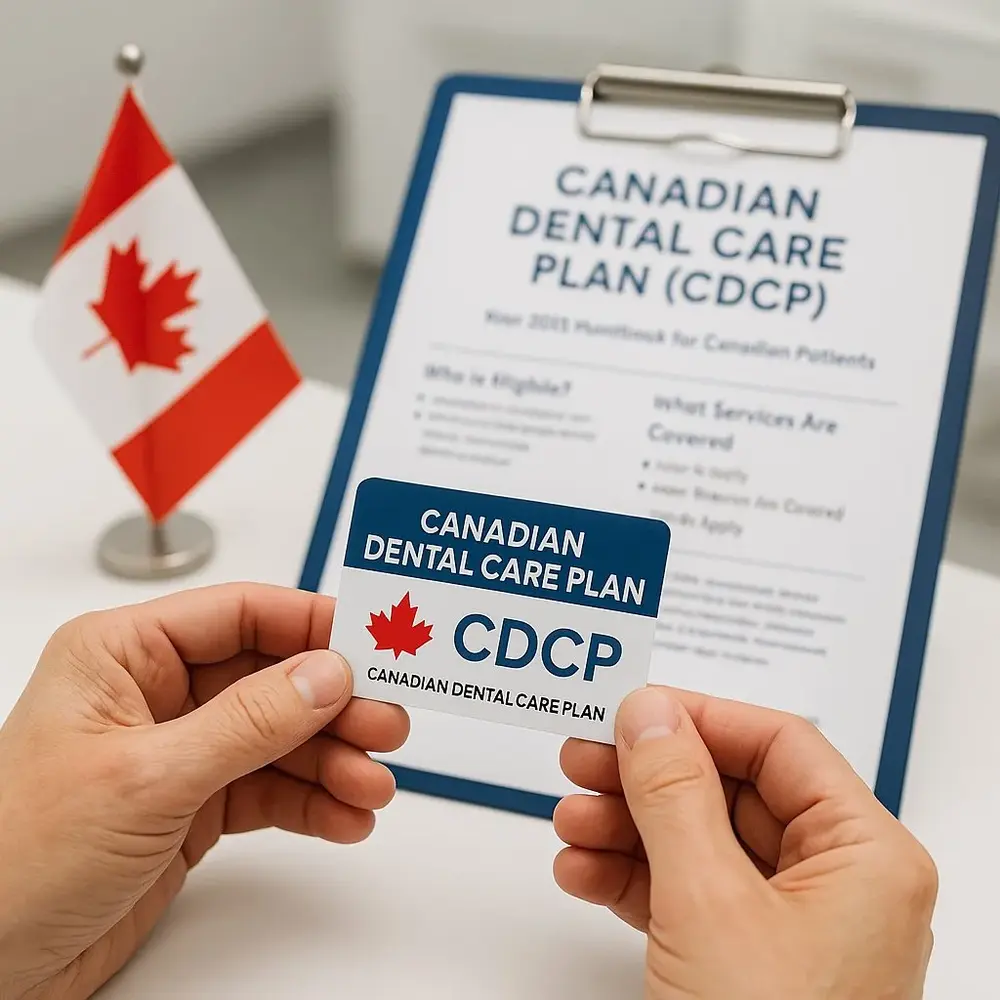
The Canada Dental Care Plan helps eligible Canadians with the cost of certain dental services. Exams, X-rays, cleanings, fillings, root canals, gum treatment, extractions and dentures are among the services that may qualify.
That does not mean every visit or treatment will be free.
How much the plan pays depends on your household income, the dental service you need, CDCP rules and the fee charged by your dental office. Some treatments also need approval before they can be provided under the plan.
For people in Fort McMurray, checking these details before treatment can make dental costs easier to understand.
Quick Answer: The Canada Dental Care Plan can help eligible Canadians pay for services such as exams, X-rays, cleanings, fillings, root canals, gum care, extractions and dentures. Coverage varies by treatment, income, CDCP fees and preauthorization requirements.
What is the Canada Dental Care Plan?
The Canada Dental Care Plan, or CDCP, is a federal program that helps qualifying Canadian residents pay for eligible oral health care.
It is intended for people who do not have access to private dental insurance and who meet the federal income and residency requirements.
The plan sets its own fees, treatment limits and approval rules. Because of this, the amount paid by the CDCP may be different from the fee charged by a dental clinic.
Who can qualify for the Canada Dental Care Plan?
Canada Dental Care Plan eligibility is based on federal requirements.
You generally need to:
- have no access to private dental insurance
- have filed the required Canadian tax return
- have a set family net income below $90,000
- be a Canadian resident for tax purposes
Your spouse or common-law partner’s tax information and access to dental insurance may also affect your application.
If you are unsure whether you qualify, check your current eligibility through the Government of Canada before arranging treatment under the plan.
What dental services does the CDCP cover?
CDCP dental coverage includes several types of preventive and necessary dental care. The exact amount available depends on the service and the plan rules that apply to you.
Some treatments can be billed directly without advance approval. Others require preauthorization.
Dental exams and preventive care
Routine dental care is included within the CDCP rules.
Eligible services can include dental exams, X-rays, professional cleanings, fluoride treatments and sealants.
These appointments give your dentist a chance to detect cavities, gum problems, damaged teeth and other concerns. If treatment is needed, the dentist can then explain which options may fall within your coverage.
Fillings and restorative treatment
Permanent fillings may qualify when a tooth has decay or damage that needs repair.
Certain crowns are also included under specific conditions. Crown treatment has clinical requirements, age restrictions and preauthorization rules, so approval should be checked before treatment starts.
A dental exam is still needed to decide whether a filling, crown or another treatment is suitable for the tooth.
Root canal treatment
Some root canal procedures are covered by the CDCP.
Root canal treatment is usually considered when the tissue inside a tooth is infected or badly damaged. Coverage depends on the tooth being treated, the procedure required and the current CDCP rules.
Some endodontic procedures need preauthorization.
Gum treatment
People with gum disease may qualify for periodontal services such as scaling and root planing.
The amount of treatment covered is subject to frequency limits. If care is needed beyond those limits, approval may be required.
Our dental team can evaluate the condition of your gums and explain what treatment is recommended before checking how the CDCP applies.
Tooth extractions and oral surgery
The plan includes certain tooth extractions and oral surgery procedures.
Our dentist will first examine the tooth and may take X-rays to see whether it can be repaired. If removal is the suitable treatment, the office can check whether the procedure falls within your CDCP dental coverage.
Some surgical procedures need approval in advance.
Have questions about your CDCP coverage?
Morrison Dental can review your treatment needs and explain estimated
coverage and possible patient costs before treatment.
Dentures
Certain complete and partial dentures are covered through the Canadian Dental Care Plan.
The rules differ depending on the type of denture. Some services can be provided without preauthorization, while others need approval first.
Replacement dentures are also subject to time limits, so previous denture treatment may affect current coverage.
Sedation and anaesthesia
Some forms of sedation can be covered when used with an eligible dental procedure.
Coverage varies by the type of sedation. Certain services have standard limits, while others require preauthorization.
Our dental office can check these requirements as part of your treatment estimate.
A simple look at CDCP coverage
| Dental Service | CDCP Coverage |
|---|---|
| Dental exams | May be covered |
| Dental X-rays | May be covered |
| Cleanings and scaling | May be covered |
| Fluoride treatments | May be covered |
| Fillings | May be covered |
| Root canal treatment | May be covered |
| Certain crowns | May be covered with approval |
| Gum treatment | May be covered |
| Tooth extractions | May be covered |
| Certain dentures | May be covered |
| Some sedation services | May be covered |
| Dental implants | Not covered |
| Cosmetic teeth whitening | Not covered |
| Veneers | Not covered |
The table is a general guide. Coverage should be checked for the specific treatment you need.
Are dental implants covered by the CDCP?
Dental implants are not included under the current CDCP benefits guide.
This also applies to procedures related to dental implants, including implant-supported crowns and implant-supported dentures.
Removable dentures are treated differently under the plan and may qualify when the CDCP requirements are met.
Does the CDCP cover cosmetic dental treatment?
Dental treatment completed only for cosmetic reasons is generally excluded.
Current exclusions include cosmetic teeth whitening and veneers. Dental implants and fixed bridges are also outside the current plan.
If a treatment has both health and appearance benefits, your dentist can explain the clinical reason for recommending it, but the CDCP still decides coverage according to its own benefit rules.
Does the CDCP cover braces or orthodontic treatment?
Limited orthodontic coverage has been identified as part of the CDCP for patients who meet specific clinical requirements.
However, patients should confirm the current status of orthodontic coverage before planning treatment. Preauthorization will apply when eligible orthodontic services become available through the program.
Do not assume braces or other orthodontic care will be paid for simply because you have active CDCP coverage.
Does the CDCP pay the full cost of dental treatment?
Sometimes, but not always.
The percentage paid by the CDCP toward its established fees is tied to adjusted family net income.
| Adjusted Family Net Income | CDCP Contribution | Patient Co-Payment |
|---|---|---|
| Under $70,000 | 100% | 0% |
| $70,000 to $79,999 | 60% | 40% |
| $80,000 to $89,999 | 40% | 60% |
There is another cost to consider.
The CDCP pays according to the fees set by the plan. A dental clinic may charge a different amount. If the clinic fee is higher, you may need to pay the difference even when your CDCP co-payment is 0%.
You are also responsible for services that are not covered.
Ask your dental office for an estimate before treatment. It is the easiest way to see what the CDCP is expected to pay and what may remain your responsibility.
What does CDCP preauthorization mean?
Some treatments need approval before they are provided.
For these services, the dental office sends the required treatment information to the CDCP administrator. The request is reviewed against the program’s clinical and coverage rules.
Preauthorization may apply to certain crowns, root canal procedures, denture services, oral surgery and sedation. It may also be required when treatment goes beyond standard frequency limits.
Approval is not automatic, which is why it is better to check before starting a treatment that requires it.
What should I ask before my dental appointment?
A short conversation with your dental office can prevent confusion later.
Before treatment, ask:
- Is my CDCP coverage currently active?
- Is this treatment covered?
- Does it need preauthorization?
- What percentage will the CDCP pay?
- Is the clinic fee higher than the CDCP fee?
- How much am I expected to pay?
You should have a clear idea of the expected cost before agreeing to treatment.
Using the Canadian Dental Care Plan in Fort McMurray
If you have active CDCP coverage and live in Fort McMurray, Morrison Dental can check your oral health and discuss the treatment you need.
Our team can also review available coverage for the proposed treatment and explain any estimated amount that may be left for you to pay.
The first step is still a dental examination. We need to see what is happening with your teeth and gums before recommending care. Once we know what treatment is needed, we can look at how your CDCP benefits apply.
Frequently asked questions
What does the Canada Dental Care Plan cover?
The Canada Dental Care Plan may cover dental exams, X-rays, cleanings, fluoride treatments, fillings, root canals, gum treatment, extractions, dentures, certain crowns and some sedation services. Limits and approval requirements vary by treatment.
Are all dental treatments fully covered?
No. Some services are only partly covered, some require preauthorization, and others are excluded. You may also have a co-payment or need to pay the difference between the CDCP fee and the dental clinic’s fee.
Does everyone get the same level of CDCP coverage?
No. The percentage paid by the CDCP depends partly on adjusted family net income. Treatment type and program rules also affect what is paid.
Are cosmetic treatments covered?
Cosmetic methods such as teeth whitening and veneers are not included under current CDCP coverage.
Are dental implants covered?
No. Dental implants and implant-related procedures are excluded under the current CDCP benefits guide.
Can my dentist check my CDCP coverage before treatment?
Yes. A dental office can check active coverage, review the treatment being recommended and identify whether preauthorization is required. The office can also provide an estimate of any amount you may need to pay.
Who may qualify for the Canada Dental Care Plan?
Applicants must meet the federal requirements, including rules related to private dental insurance, Canadian tax filing, residency and adjusted family net income.
Have questions about your CDCP coverage in Fort McMurray?
Knowing that you have CDCP coverage is only part of the picture. You also need to know whether the treatment you require is covered and what your portion of the cost may be.
At Morrison Dental, we can examine your dental needs, explain the treatment being recommended and review the expected CDCP coverage before you proceed.
Contact Morrison Dental to book an appointment and discuss your Canada Dental Care Plan coverage.